
AREA
Cognitive Neuroscience
SITE
Alzheimer’s & dementia, April 29, 2026
TYPE
Article
YEAR
2026
Authors: Joaquin Migeot – Andrea Slachevsky – Henríquez, F., Riquelme, P., Forno, G., Henríquez, R., Lillo, P., Thumala-Dockendorff, D., Okuma, C., Campo, C. G., Hornberger, M., Aboitiz, F.
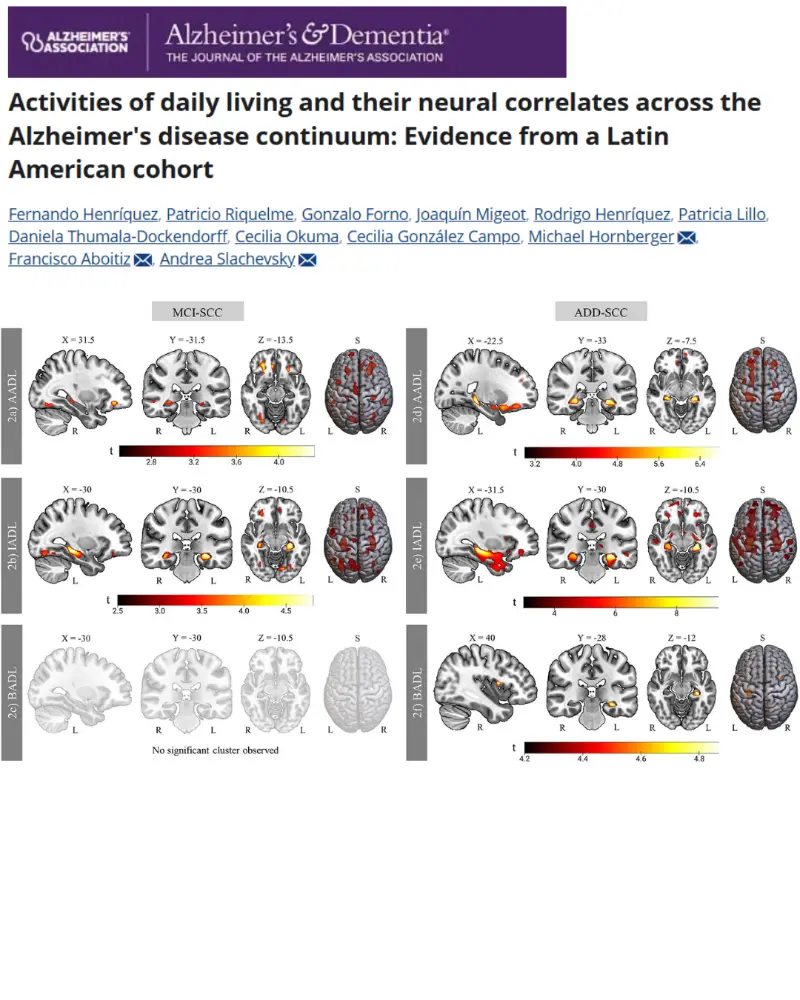
Abstract: This study examines the progression of functional decline across the Alzheimer’s disease continuum in older adults from Latin America, integrating assessments of daily living activities with structural brain imaging. Findings reveal a hierarchical pattern of decline, from advanced to instrumental and basic activities, with distinct but overlapping gray matter correlates, highlighting the clinical and neuroanatomical relevance of functional changes in early disease stages.
Latest publications
-
Activities of daily living and their neural correlates across the Alzheimer’s disease continuum: Evidence from a Latin American cohort
-
Dementia research priorities in Latin America and the Caribbean: Findings from a multi-country stakeholder survey
-
A systematic review of brain health in centenarians
-
Speech clocks decode dementia phenotypes, social exposome, and biological aging
-
Developing roadmaps for advancing practice, research, and policy in the arts and health
-
The arts as a global health resource: key priorities for future research